
Why Strata Systems Adapt Faster Than Strata Reforms
Strata laws change occasionally. Strata systems change every day …

Synopsis
Governments like to think that reform changes systems.
A problem is identified. There is consultation. A policy response is developed. Legislation is drafted, debated and passed. Regulations are prepared. Eventually, the new rules commence.
And the system changes.
Or, so the theory goes.
But strata systems do not wait patiently for governments to finish reforming them. They are already moving.
Owners are making decisions. Committees are responding to problems. Strata managers are changing procedures. Lawyers are giving advice. Insurers are repricing risk. Developers are restructuring transactions. Consultants are developing new services. Contractors are changing what they will do and what they will charge.
Sometimes those changes occur after strata reform. Sometimes they begin while strata reform is being developed. And, sometimes the system starts adapting as soon as it can see strata reform coming.
That creates an uncomfortable possibility for strata reform.
By the time a reform arrives, the strata system it was designed to change may already have started changing around it.
[a 10:50 minute read, with 2876 words]
Introduction – Strata Reform Is Only the Beginning
We tend to describe strata reform as though legislation causes outcomes.
Something in the strata system is not working.
Government investigates it.
Stakeholders are consulted.
Recommendations are made.
Legislation follows.
The legislation commences.
Problem solved.
Except commencement is not the end of that process.
It is the beginning of another one.
Adaptation.
Every participant affected by the new rules starts deciding what those rules mean for them.
Some comply.
Some over-comply.
Some misunderstand them.
Some introduce another form.
Some obtain another report.
Some change their contracts.
Some transfer the risk.
Some increase their fees.
Some stop doing whatever has become more difficult.
Some find another way of doing substantially the same thing.
And some will have started doing those things before the legislation even commenced.
Because strata reform does not enter an empty regulatory space.
It enters a living system. And living systems respond.
Strata is an Adaptive System
One of the recurring mistakes in thinking about the strata system is to treat it principally as a body of law. It isn't.
Law establishes much of the architecture of strata, but the operational strata system consists of much more including:
owners and occupiers;
owners corporations and committees;
strata managers and building managers;
developers;
insurers and brokers;
lawyers;
engineers;
contractors;
accountants;
lenders;
regulators;
tribunals and courts; and
an increasingly large ecosystem of businesses selling things to all of them.
Each participant sees the strata system differently and has:
Different information.
Different incentives.
Different risks.
Different financial interests.
Different time horizons.
And different abilities to influence what happens next.
Change a rule and those participants do not simply implement it.
They respond to it. Their responses cause other participants to respond. Those responses create further responses.
Eventually, the operational strata system can look quite different from the strata system described in the legislation.
Reform changes the formal strata system. Adaptation determines much of what the operational strata system becomes.
And the difficulty for reformers is not merely that those processes happen at different speeds. They can also happen in different directions.
The Strata System may Move Before the Strata Laws Do
There is another complication.
Adaptation does not necessarily wait for commencement.
Governments usually announce reforms before implementing them with:
discussion papers;
reviews;
election commitments;
exposure drafts;
consultations;
Bills;
parliamentary debates;
transitional periods;
draft regulations; and
industry briefings.
Sometimes there are years of warning about where strata regulation is heading.
That information enters the strata system too. And rational participants respond to information about future rules just as they respond to current ones.
An insurer may change its appetite for a risk.
A developer may change the structure of future projects.
A strata manager may change procedures.
A lawyer may advise clients to complete something before the law changes.
An owners corporation may accelerate a decision.
A service provider may develop a product designed around the expected regime.
Or participants may simply move activity from the pathway government intends to regulate towards another one.
None of this necessarily involves evading the law. Plus, there may not yet be a law to evade.
It is better understood as anticipatory adaptation.
The strata system sees something coming and begins repositioning itself.
Sometimes that will help strata reform. Participants prepare early and implementation becomes easier. But sometimes it resembles a collective side-step.
The reform is aimed at where the strata system was standing. But by commencement, parts of the strata system have already moved.
And that suggests something more important.
A foreshadowed strata reform can itself become a system intervention.
Not legally. But operationally.
The announcement changes the information environment in which participants make decisions. Changed information can change behaviour. Changed behaviour can change the system.
So a sufficiently credible reform signal can begin affecting the strata system before the reform has any legal effect at all.
The sequence can become:

By the time the legal intervention arrives, the operational intervention may already be underway.
Two Speeds — Perhaps Three in Strata Systems
This exposes one of the structural difficulties of strata title reform.
Formal reform moves through something like below, and can take years. Operational adaptation can be much faster, that can take weeks. But anticipatory adaptation can begin earlier still, sometimes that happens before Parliament has acted at all.
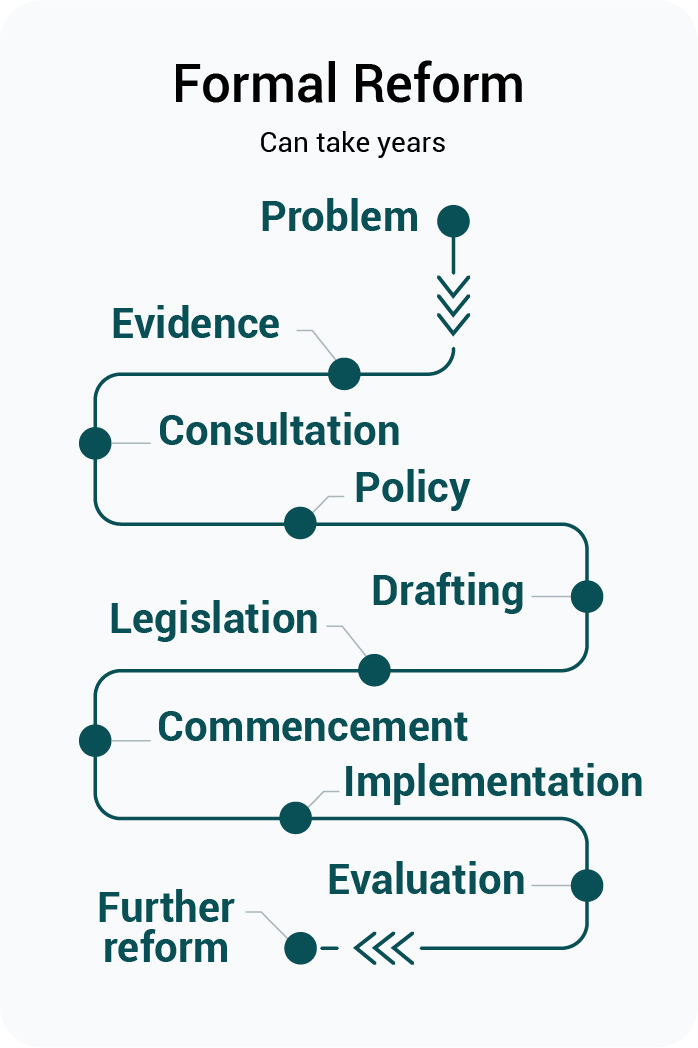
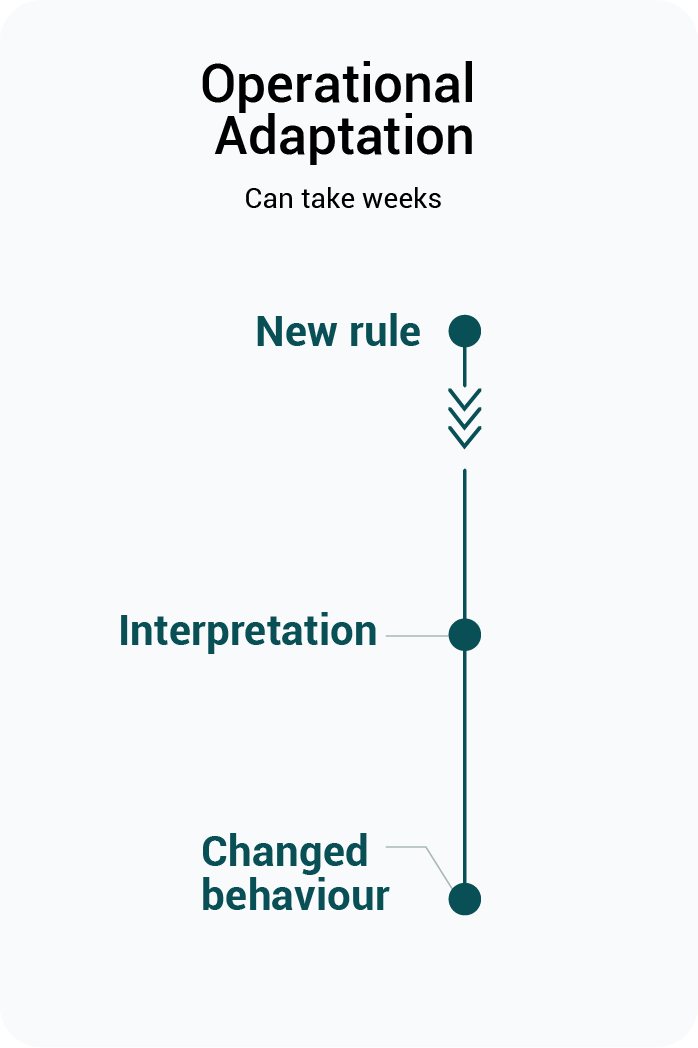
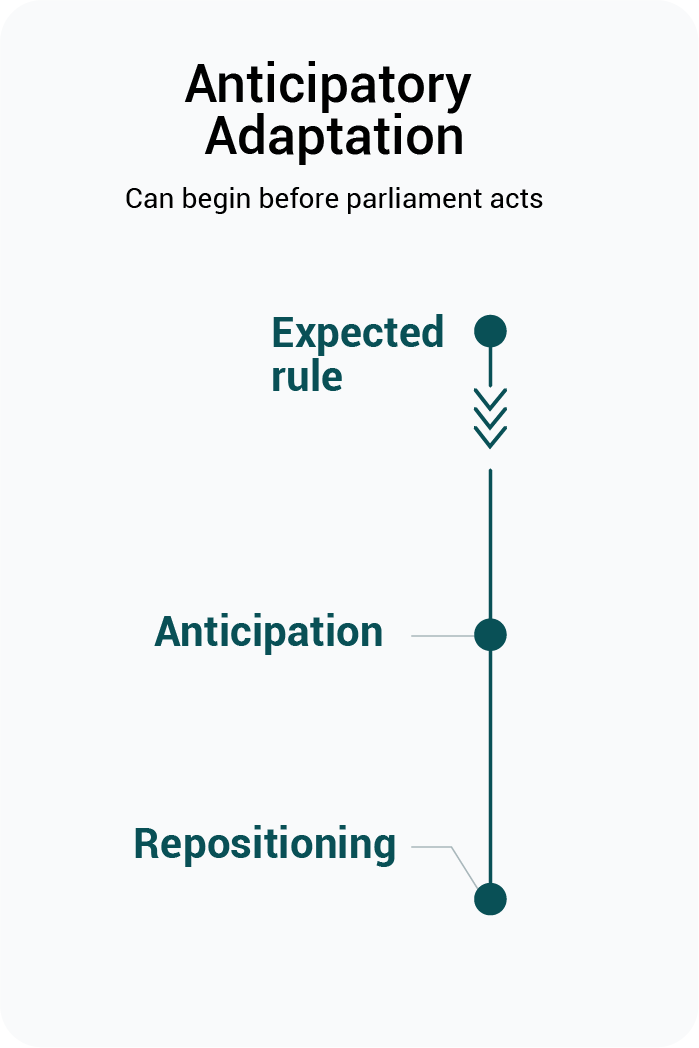
So there are really three movements occurring.
Reform.
Anticipation.
Adaptation.
And they operate on different clocks.
Governments reform periodically.
Strata systems adapt continuously.
And sophisticated participants may adapt prospectively.
That creates a persistent asymmetry where the reform process is trying to regulate a strata system that is changing while the reform itself is being designed.
Adaptation is not the Same as Avoidance
This difference between adaptation and avoidance is important as it would be easy to make the argument too cynical.
Strata participants are not necessarily sitting around looking for ways to defeat government policy. Most adaptation is simply rational behaviour.
Consider a strata committee facing a new obligation.
The committee becomes more cautious.
The committee seeks advice.
The advice recommends obtaining an expert report.
The expert identifies further investigation.
The strata manager develops a procedure to ensure the obligation is documented.
The insurer wants evidence that the procedure has been followed.
Soon, something intended to improve an outcome has generated another chain of processes, documents, advisers and costs.
Every decision in that chain may be perfectly rational. Yet the collective result may be quite different from what the reformer imagined.
This is one of the recurring characteristics of strata systems:
That locally rational behaviour can produce systemically irrational outcomes.
The problem does not require bad actors. Sometimes it is produced by perfectly sensible actors responding sensibly to the environment they have been given.
How the Strata System Metabolises Reform
Perhaps the better way to think about this is that strata systems do not merely implement reforms. Intead they metabolise them.
A new rule enters the strata system. Then the system converts it into other things.
Interpretation
Someone has to decide what the new strata rule means.
Strata managers, lawyers, insurers, regulators and industry organisations begin interpreting it.
Those interpretations can shape operational behaviour long before a tribunal or court decides what the legislation actually means.
Proceduralisation
The substantive obligation becomes a strata process.
A form.
A checklist.
A motion.
A certificate.
A report.
An approval.
Another item on the AGM agenda.
The strata reform has now become administration.
Risk Transfer
Participants ask the familiar question: Who carries the risk if this goes wrong?
Contracts change.
Indemnities appear.
Insurance requirements increase.
Expert advice is obtained.
Responsibility is divided between more participants.
The strata risk has not necessarily disappeared. It has moved.
Cost Transfer
The same thing happens with strata costs and finances.
Compliance costs become:
management fees;
professional fees;
insurance premiums;
consultancy costs;
contractor prices;
levies; and/or
transaction costs.
Again, the strata cost has not disappeared. It has moved or become distorted.
Intermediation
As strata rules become more complicated, participants need help understanding them.
That creates greater reliance on strata managers, lawyers, engineers, consultants and other specialists.
A reform intended to empower strata owners may therefore have the unintended effect of increasing their dependence upon strata intermediaries.
Substitution
If one pathway becomes difficult, expensive or risky, strata participants may use another.
The activity does not necessarily stop. It changes form.
This is where anticipatory adaptation to strata reforms can become especially important.
If the direction of reform is known early enough, substitution can begin before the regulated pathway is even closed.
Normalisation
Eventually all of this becomes ordinary.
People stop remembering:
why the form exists;
why the report is required;
why the contract contains that clause; or
why nobody will approve something without another certificate.
It becomes: “That's just how strata works.”
At that point, yesterday's response to strata reform has become today's strata system.
The Strata Reform Paradox
This leads to a more difficult possibility.
Reforms intended to correct strata system failures can sometimes reinforce the structures that produced them.
Consider complexity, risk, or governance failure:
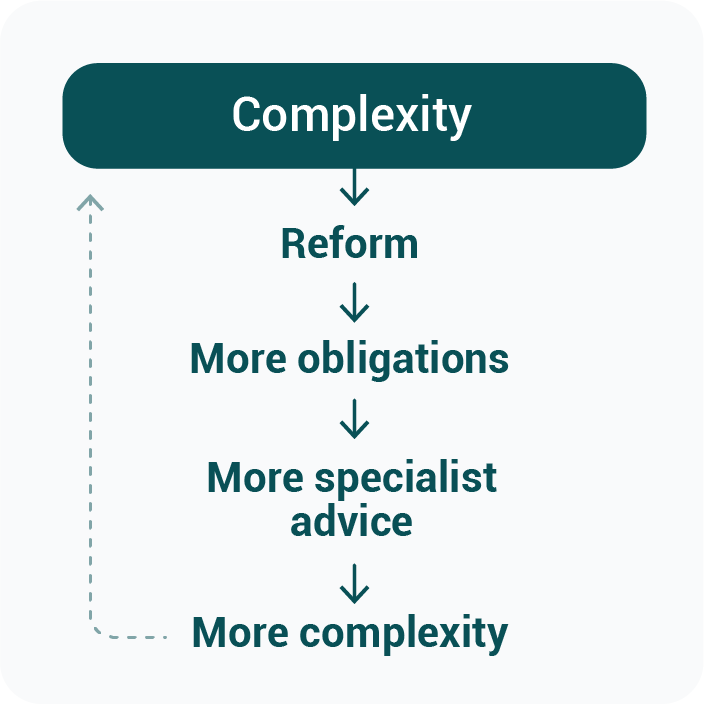
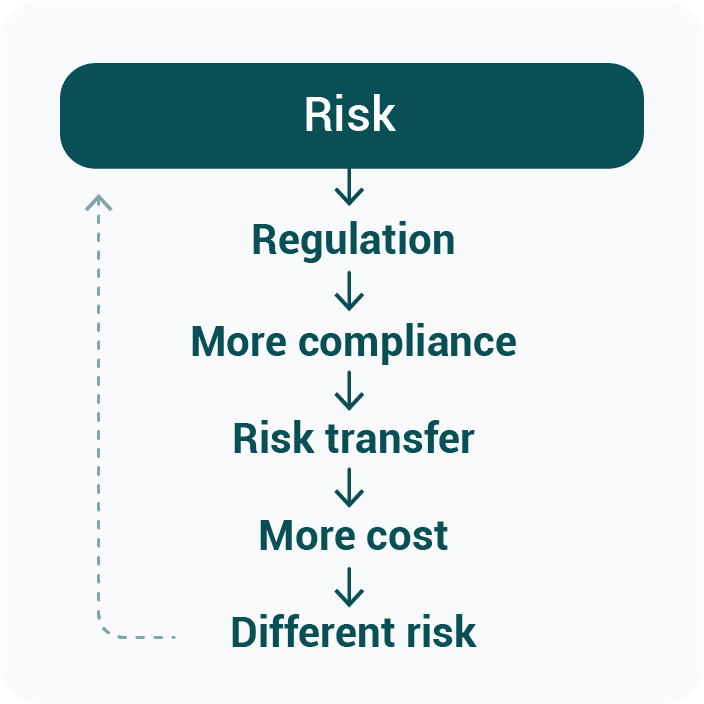
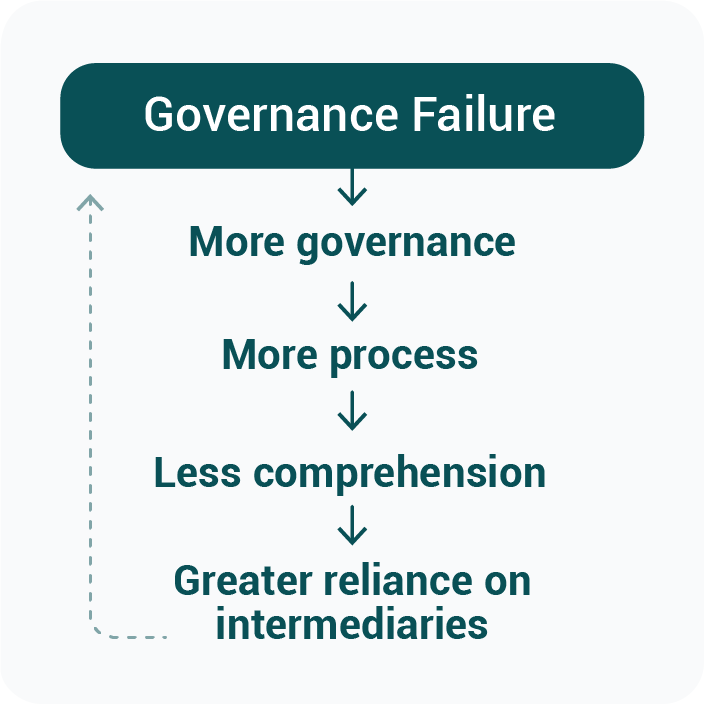
In each case, the strata system has not necessarily rejected the reform. It has absorbed it, metabolised it, and converted it into new system behaviour.
The strata reform remains in the legislation. But its operational consequences have become something larger and more complicated.
Strata Capital Does This Too
This should sound familiar.
GoStrata's Capital Distortion doctrine examines the ways strata systems misperceive, misallocate and transform capital while appearing financially rational.
System adaptation helps explain how that can happen.
Introduce a new strata scheme obligation and its economic consequences might emerge as higher levies, deferred expenditure, professional fees, insurance costs, lower property values, owner hardship or future liabilities.
The underlying economic burden does not necessarily disappear because regulation has changed. It changes location or form.
Capital Distortion is therefore not separate from System Adaptation. It is one place where adaptation becomes economically visible.
When regulation changes one capital pathway, the strata system may redirect the burden through another.
Capital converts while the strata system adapts.
Strata Has Too Many Clocks
There is another GoStrata idea lurking underneath these issues. That the strata system does not operate on one clock.
Budgets generally operate annually.
Committees operate over shorter governance cycles.
Owners come and go.
Insurance reprices periodically.
Professional practices can change almost immediately.
Buildings deteriorate over decades.
Liabilities can remain latent for years.
Government reform operates on another clock again.
These strata clocks are not synchronised.
The strata system predominantly makes decisions through some of its shortest clocks while many of its most important consequences emerge through its longest ones.
Reform adds yet another timing problem that by the time reform catches the strata system it was designed to change, the system may already have become something else.
And when that happens, three further problems begin to emerge.
Adaptation can disperse causation.
It can obscure observation.
And it can outpace correction.
So, Who Is Accountable?
Suppose a strata reform produces an unexpected result.
Who caused it?
Parliament?
The regulator?
The owners corporation?
The committee?
The strata manager?
The insurer?
The lawyers?
The engineers?
The market?
Probably none of them. And perhaps all of them a little.
The eventual outcome may have emerged from hundreds or thousands of individually defensible decisions distributed across the strata system.
Responsibility becomes dispersed. But accountability still wants to find someone.
That creates another characteristic strata system problem: The distance between who contributes to an outcome and who can realistically be held accountable for it becomes wider.
Adaptive systems can distribute causation much more easily than governance systems can distribute accountability.
The system can therefore produce an outcome without producing anyone who clearly owns that outcome. That is more than an inconvenience when something goes wrong.
It may be a structural characteristic of the strata system itself.
And How Would We Even Know?
There is an even more basic problem.
How does government know how the strata system adapted?
It knows what legislation Parliament passed.
It knows when regulations commenced.
It may know how many complaints were made.
It may know how many tribunal applications were filed.
But does it know:
How committees changed their behaviour?
How much additional professional advice was obtained?
How insurance underwriting changed?
Which activities became more expensive?
Which decisions stopped being made?
What contractual clauses changed?
What risks moved between participants?
What informal workarounds emerged?
What happened to the underlying economics?
Usually, not very well if at all.
So the strata system does not merely adapt faster than reform. It may adapt faster than our ability to observe the adaptation.
And there is a deeper problem.
A system cannot reliably correct what it cannot reliably see.
If the information generated by the strata system principally records process, transactions and formal compliance, while many important outcomes emerge through dispersed behaviour, transferred risk, converted capital and delayed consequences, then the strata system may systematically observe the wrong things.
The problem is no longer simply missing information. It is a mismatch between the information the strata system produces and the information it needs in order to understand itself.
That matters because the next attempt at strata reform will inevitably depend upon what the system thinks happened last time.
When Strata Reform Produces More Strata Reform
Here is where things can start going badly for strata system participants.
A problem is identified.
Government reforms it.
The strata system adapts.
The result is not what was expected.
But the adaptation is poorly observed or misunderstood.
So the apparent answer is obvious: More strata reform.
Another obligation.
Another disclosure.
Another approval.
Another process.
Another regulatory power.
Another amendment to an already enormous statute.
The strata system adapts again.
And the cycle continues:
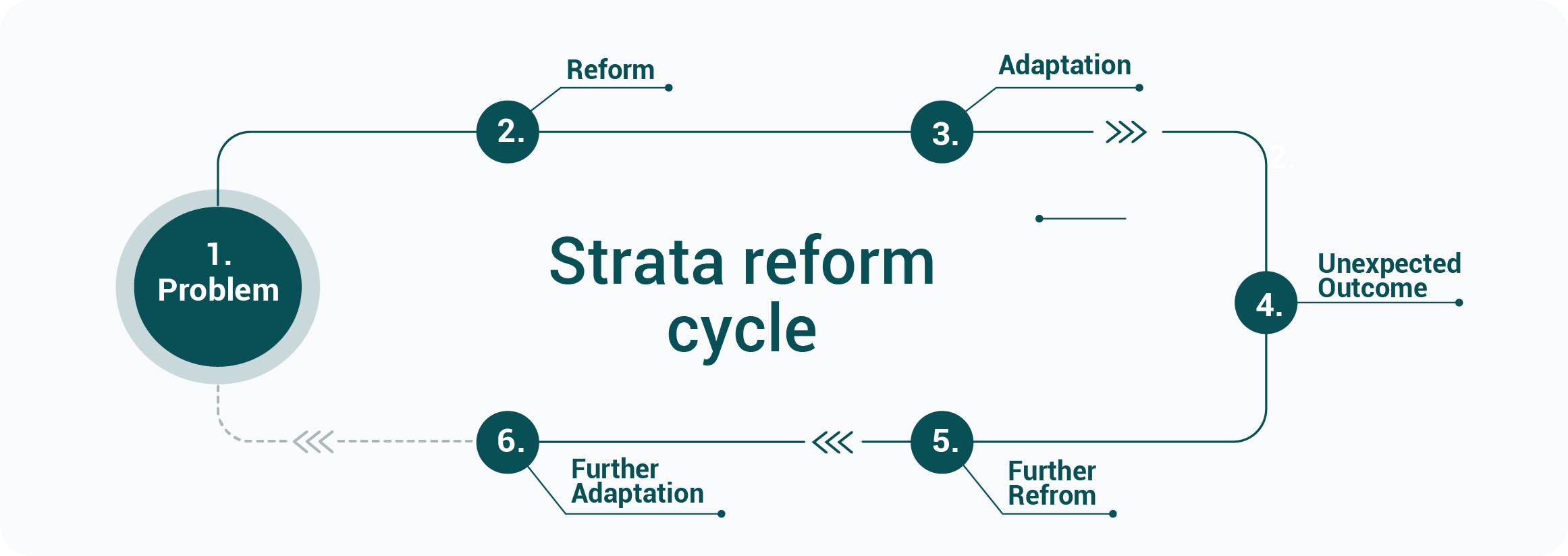
The legislation grows.
The operational system becomes more complicated.
Intermediation increases.
Comprehension falls.
Compliance becomes more expensive.
Yet the original problem may remain.
Which may explain something GoStrata has been examining for some time.
Strata law keeps trying harder. But somehow the strata system keeps missing the target.
Perhaps that is partly because the target keeps moving. But perhaps it is also because the strata system responsible for reform does not always know where the target moved, why it moved or who moved it.
Reforming Something That Moves
None of this means the strata system cannot be reformed. Nor does it mean reform is pointless.
It means we may need to think differently about what strata reform is.
If strata is an adaptive system, reform cannot simply be to write better rules and wait for compliance. It needs to ask what happens next.
What behaviour will this rule encourage?
What behaviour will it discourage?
Where will the risk move?
Where will the cost move?
Who will become more powerful?
Who will become more dependent?
What new intermediary will be required?
What alternative pathway will become attractive?
What will sophisticated participants do before commencement?
And what information will tell us whether any of those things actually happened?
That suggests a different model for strata reform that involves:
Defining the desired system outcome.
Understanding the incentives.
Anticipating likely responses.
Intervention.
Watching what happens.
Measuring the outcome.
Identifying adaptations.
Learning.
Correcting quickly.
Repeating the cycle.
Strata reform should therefore be treated as an intervention to be observed, not a solution to be declared.
That is less like traditional legislative reform. And much more like managing an adaptive system.
The objective is not necessarily to design the perfect strata reform.
It may be to create a strata reform system capable of learning and correcting quickly enough to keep pace with the system it is trying to change.
Conclusions — The Moving Strata Target
There is a deceptively simple idea underneath all of this analysis.
A strata system is not changed simply because its legislation changes.
Every strata reform enters an existing network of incentives, information, capital, institutions, relationships and behaviour.
That network responds.
Sometimes after the reform. Sometimes while the reform is being implemented. And sometimes before the reform even arrives.
That does not make strata reform impossible. But it does make strata a moving target.
And once the strata system moves, two further questions immediately arise.
Who is accountable for what the adapted system produces?
Does the strata system generate enough useful information for anyone to know what it has produced?
Those questions take us beyond strata reform itself. They point towards deeper structural characteristics of strata systems that GoStrata will return to.
But for now, perhaps the most important question for strata reformers is not simply: Will this new strata rule work?
It is: What will the strata system become once everyone starts responding to it?
Because while governments are reforming strata systems, strata systems are already adapting to the reforms.
And sometimes they have started moving before anyone says go.
GoStrata System Principles — System Adaptation
Strata systems continuously adapt to changes in law, risk, cost, information and incentives.
Adaptation can occur in anticipation of reform, during implementation or after commencement. And, those adaptations can reinforce, redirect, dilute or transform the intended effect of an intervention.
Governments reform periodically. Systems adapt continuously.
Reader Takeaway
Changing strata rules does not determine the outcome.
It changes the environment in which thousands of strata participants decide what to do next.