

GoStrata Primary Doctrine 03 Capital Distortion
Status: Working Draft
Classification: Primary Doctrine
Issue: 0.2
Date: July 2026
Supersedes: Issue 0.1 Working Draft
Related Doctrines: Incentive Alignment; Governance Substitution; Accountability Gap; Information Failure; Fiduciary Distortion; Compliance Theatre
1. Purpose and Scope
This doctrine articulates a core analytical principle used by GoStrata to explain how governance structures alter economic outcomes within strata title systems.
It is intended to:
provide a stable conceptual framework for analysing the economic behaviour of strata systems;
explain recurring patterns in capital allocation, asset values, liabilities and financial outcomes;
support consistent reasoning across jurisdictions, sectors and case studies; and
underpin applied commentary, policy critique, advisory work and reform proposals.
This doctrine is not prescriptive.
It is explanatory.
It seeks to explain why economic outcomes within strata systems frequently diverge from those expected in ordinary markets, not because of individual misconduct, but because of the way the system itself reshapes economic relationships.
2. Definition
Capital Distortion is defined as:
the systematic reshaping of economic value, economic obligations and capital behaviour by the governance structure of a strata title system, causing capital allocation, asset values, liabilities, pricing, incentives or financial outcomes to diverge from the underlying economic reality or intended function of the scheme.
This definition operates independently of particular legal regimes, industry practices or individual participants.
3. Core Proposition
The central proposition of this doctrine is that:
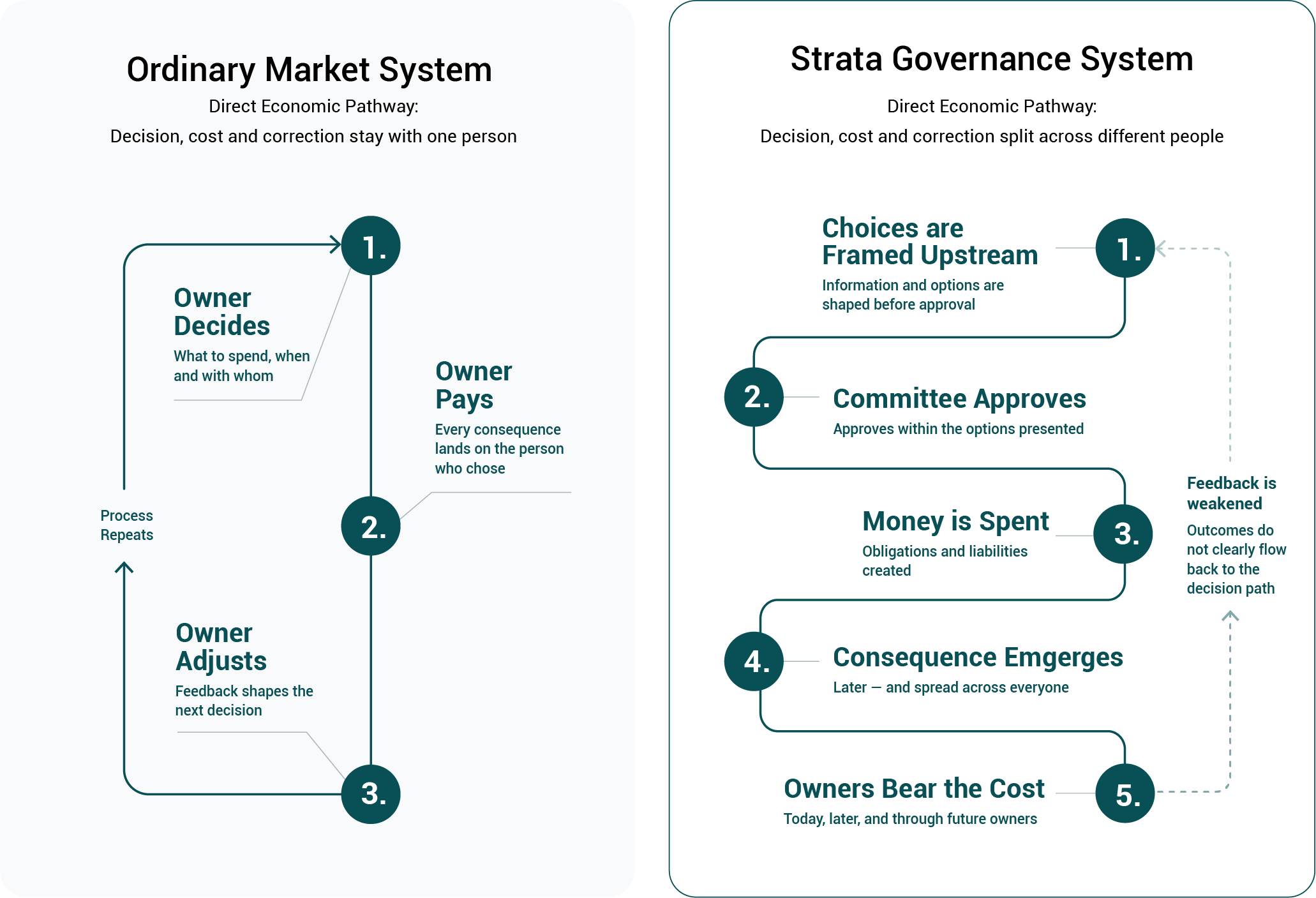
strata title systems systematically alter the behaviour of capital because governance structures separate economic decision-making from economic ownership, economic risk and economic consequence.
In ordinary markets:
those controlling expenditure usually bear its consequences;
those owning assets usually bear the consequences affecting those assets;
those bearing liabilities generally influence decisions affecting those liabilities;
prices provide relatively direct feedback;
and economic consequences are more readily recognised.
Strata systems progressively weaken these relationships.
As governance layers increase:
spending authority diffuses;
accountability weakens;
incentives separate;
liabilities become obscured;
future obligations become disconnected from present decisions;
information fragments; and
economic consequences become collectivised, delayed or transferred.
The result is not merely inefficient spending.
It is the structural distortion of economic reality.
The Separation of Decision from Consequence
4. Structural Conditions
This doctrine applies where one or more of the following structural conditions exist:
economic ownership is separated from economic decision-making;
financial consequences are delayed or transferred;
liabilities are collective, contingent or poorly understood;
information concerning economic position is incomplete or asymmetrical;
governance authority is delegated away from economic risk bearers;
transaction costs increase through governance complexity;
market feedback is weakened or delayed; or
economic costs and economic benefits accrue to different participants.
These conditions may arise through legislation, governance structures, contracts, market practice or combinations of these factors.
5. Explanatory Function
For the purposes of this doctrine, capital extends beyond money.
Capital includes:
cash and cashflows;
reserve funds;
borrowing capacity;
lot values;
common property value;
use rights and economic benefits;
current liabilities;
future liabilities;
contingent liabilities;
contractual obligations;
risk exposures;
and other forms of economic value or economic burden.
The doctrine explains how governance structures may:
alter;
redistribute;
delay;
conceal;
amplify;
convert;
subsidise; or
misallocate
these forms of capital.
It explains outcomes that cannot be adequately accounted for solely by:
individual ethics or professionalism;
isolated misconduct;
disclosure or transparency alone;
financial reporting alone;
information asymmetry alone; or
compliance-based regulatory analysis.
It focuses upon structural economic behaviour rather than participant intent.
6. Capital Visibility
One of the recurring sources of Capital Distortion is the difference between a scheme's:
Actual Capital Position and Perceived Capital Position.
Participants frequently assess financial health by reference to:
bank balances;
current levies;
annual budgets;
reserve funds; or
recent expenditure.
However, a scheme's actual capital position also includes:
existing liabilities;
future maintenance obligations;
latent defects;
contingent liabilities;
insurance exposure;
contractual commitments;
statutory obligations;
and other economic rights and restrictions.
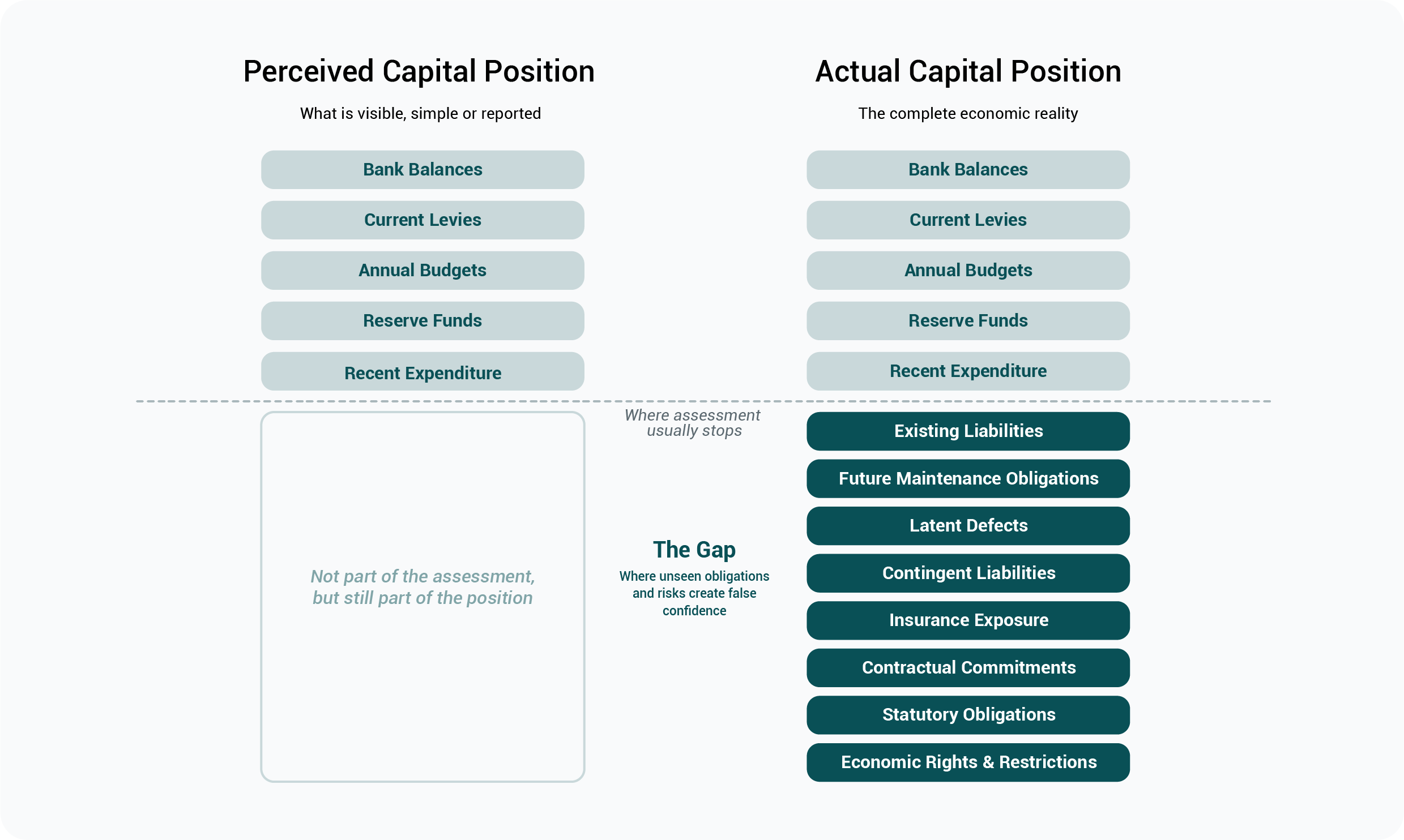
The greater the difference between actual and perceived capital position, the greater the potential for Capital Distortion.
7. Capital Conversion
Capital within strata systems frequently changes form.
Governance structures convert:
money into asset value;
asset value into money;
cash savings into future liabilities;
deferred expenditure into contingent obligations;
common property into private economic benefit;
liabilities into future cash expenditure;
and present decisions into future economic consequences.
Many of the most significant distortions arise not from the movement of money itself, but from the conversion of one form of capital into another while obscuring the underlying economic consequences.
8. Predictive Implications
Where Capital Distortion is significant, the following outcomes are likely to emerge over time:
deferred maintenance;
repeated special levies;
underfunded reserves;
hidden or underestimated liabilities;
inflated operating costs;
governance friction;
distorted procurement outcomes;
reduced asset values;
inefficient capital allocation;
increased reliance upon borrowing;
transfer of liabilities between owners or generations of owners; and
persistent divergence between reported financial position and actual economic position.
These outcomes may arise even where participants act honestly, competently and in compliance with applicable obligations.
9. Relationship to Other Doctrines
Capital Distortion operates as one of the primary explanatory doctrines within the GoStrata ARC framework.
It relates to other doctrines as follows:
Incentive Alignment
Explains why participants behave as they do.Governance Substitution
Explains how authority moves away from owners.Capital Distortion
Explains how those governance arrangements reshape economic outcomes.Accountability Gap
Explains why distorted outcomes often persist without meaningful consequence.Information Failure
Explains why distorted economic positions frequently remain hidden or misunderstood.Fiduciary Distortion
Explains how fiduciary concepts may persist while economic risks are externalised.Procedure and Compliance Theatre
Explains how procedural activity may substitute for meaningful economic accountability.
Each doctrine addresses a distinct analytical dimension and should not be treated as interchangeable.
10. Limits of this Doctrine
This doctrine does not assert that:
all strata expenditure is excessive;
all financial decisions are inefficient;
all liabilities are hidden;
commercial profit is inappropriate;
all participants behave improperly; or
adverse outcomes are inevitable.
Rather, it identifies recurring structural tendencies that influence economic behaviour and economic outcomes in the absence of countervailing governance design.
11. Use and Citation
This doctrine may be cited in GoStrata ARC materials, including:
analytical articles;
doctrine papers;
case studies;
advisory memoranda;
policy submissions;
governance frameworks;
reform proposals; and
educational materials.
When cited, it should be referred to as:
Captial Distortion Doctrine (GoStrata ARC, Primary Doctrine, Issue 1.0)
12. Location
This doctrine is accessible at the GoStrata website. [link].
13. Version Control
This doctrine is subject to revision as GoStrata ARC analysis evolves.
Minor refinements will be reflected in incremental issue updates (e.g. Issue 1.1).
Substantive reconceptualisation will result in a new major issue (e.g. Issue 2.0).
14. Theoretical foundations (non-exhaustive)
Douglass North: Institutions, Institutional Change and Economic Performance
Ronald Coase: The Nature of the Firm; The Problem of Social Cost
Oliver Williamson: Markets and Hierarchies; The Economic Institutions of Capitalism
Michael Jensen & William Meckling: Theory of the Firm: Managerial Behaviour, Agency Costs and Ownership Structure
Mancur Olson: The Logic of Collective Action
Elinor Ostrom: Governing the Commons
George Akerlof: The Market for Lemons
Joseph Stiglitz: Information Economics and Market Failure
Donella Meadows: Thinking in Systems
James Buchanan & Gordon Tullock: The Calculus of Consent
End of Doctrine