

GoStrata Primary Doctrine 01 Incentive
Alignment
Status: Canonical
Classification: Primary Doctrine
Issue: 1.0
Date: 01 March 2026
Supersedes: Not Applicable
Related Doctrines: Governance Substitution; Capital Distortion; Fiduciary Distortion; Information Failure; Compliance Theatre.
1. Purpose and Scope
This doctrine articulates a core analytical principle used by GoStrata to explain persistent patterns of behaviour and outcomes within strata title systems.
It is intended to:
provide a stable conceptual reference point for systemic analysis,
support consistent reasoning across jurisdictions, sectors, and case studies, and
underpin applied commentary, policy critique, and downstream reform proposals.
This doctrine is not prescriptive.
It is explanatory.
2. Definition
Incentive Alignment is defined as:
the degree to which a system’s reward, risk, authority, and accountability structures are aligned with the long-term interests of the parties the system is intended to serve
This definition operates independently of specific legal regimes, industry practices, or individual actors.
3. Core Proposition
The central proposition of this doctrine is that:
strata title systems consistently produce poor outcomes not because participants are uniquely unethical, incompetent or self interested, but because the system’s incentives are misaligned with strata owners’ interests
Where incentives are misaligned, behaviour becomes predictable.
Outcomes repeat across buildings, jurisdictions, and regulatory settings.
From Incentive Alignment to Incentive Misalignment
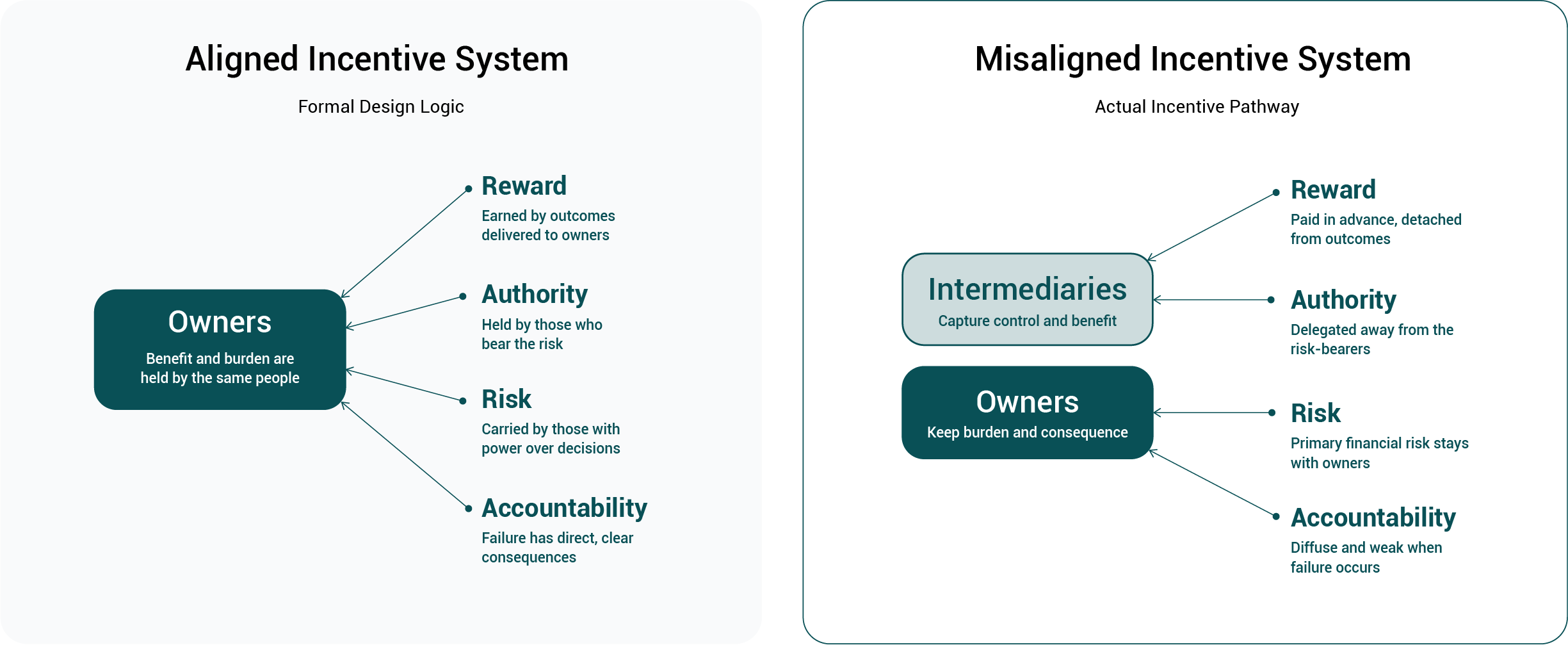
Every strata system runs on the same four forces. What decides the outcome is where each force lands: aligned systems hold them together; misaligned systems split benefit from burden.
4. Structural Conditions
This doctrine applies where one or more of the following structural conditions are present:
owners bear the primary financial risk,
decision-making authority is delegated away from risk-bearers,
information flows are intermediated rather than direct,
payments are structured in advance or indirectly, and
accountability for failure is diffuse or weak.
These conditions may arise through law, contract, market practice, administrative design, or a combination of these factors.
5. Explanatory Function
This doctrine explains outcomes that cannot be adequately accounted for by:
individual ethics or professionalism,
isolated misconduct or “bad actors”,
disclosure or transparency alone,
information deficits or asymmetries alone, or
compliance-based regulatory analysis.
It focuses on system design rather than participant intent.
Where a system requires exceptional behaviour to function acceptably, the system itself is already failing.
6. Predictive Implications
Where Incentive Alignment is weak or absent, the following outcomes are likely to emerge over time:
behaviour that is rational for participants but adverse to strata owners’ long-term interests,
persistence of poor outcomes despite repeated reform efforts, and
increasing reliance on process, disclosure, and education in place of structural change.
These outcomes may arise even where participants act in good faith and in formal compliance with applicable obligations.
7. Relationship to Other Doctrines
This doctrine operates as a root explanatory principle within the GoStrata ARC framework.
It relates to other GoStrata primary doctrines as follows:
Governance Substitution
Explains how misaligned incentives displace formal governance with administrative or commercial control.Capital Distortion
Explains how financial structures stabilise intermediaries rather than outcomes.Accountability Gap
Explains how misaligned incentives weaken consequence mechanismsInformation Assymmetry: Explains how unequal control of information stabilises misaligned incentive structures.
Fiduciary Distortion
Explains how fiduciary language persists while fiduciary risk is externalised.Procedure & Compliance Theatre
Explains how activity and process substitute for accountability without altering incentives.
Each doctrine addresses a distinct analytical dimension and should not be treated as interchangeable.
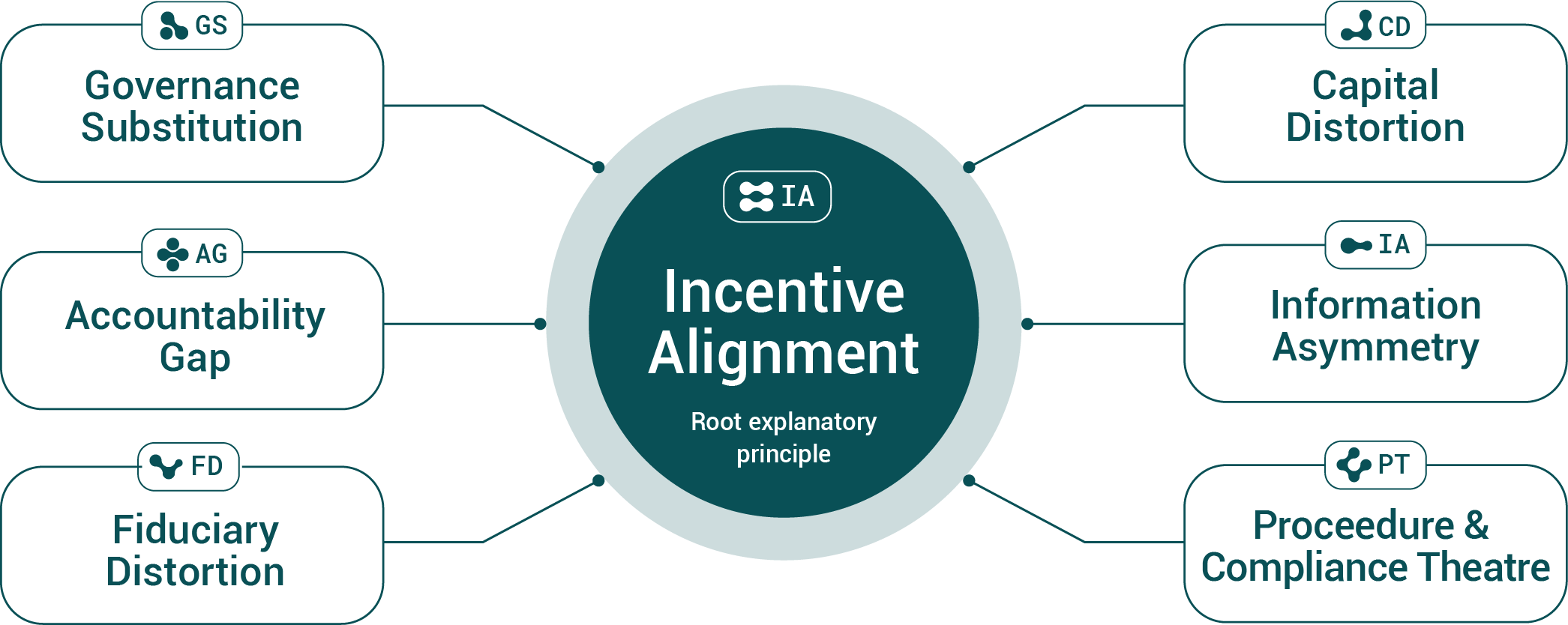
Incentive Alignment provides the root logic. The related doctrines show how that logic appears in practice.
8. Limits of this Doctrine
This doctrine does not assert that:
all participants behave improperly,
unethical conduct is irrelevant, or
adverse outcomes are inevitable in every instance.
Rather, it identifies structural tendencies that shape behaviour and outcomes in the absence of countervailing design features.
9. Use and Citation
This doctrine may be cited in GoStrata ARC materials, including:
analytical articles,
case reviews,
policy submissions,
advisory frameworks, and
reform proposals.
When cited, it should be referred to as:
Incentive Alignment Doctrine (GoStrata ARC, Primary Doctrine, Issue 1.0)
10. Location
This doctrine is accessible at GoStrata website here.
11. Version Control
This doctrine is subject to revision as GoStrata ARC analysis evolves.
Minor refinements will be reflected in incremental issue updates (e.g. Issue 1.1).
Substantive reconceptualisation will result in a new major issue (e.g. Issue 2.0).
12. Theoretical Foundations (non exhaustive)
Douglas North: Institutions, Institutional Change and Economic Performance
Mancur Olson: The Logic of Collective Action
Oliver Williamson: Transaction cost economics
Michael Jensen & William Meckling: Agency theory
Elinor Ostrom: Institutional Governance and Collective Action Dynamics
End of Doctrine