

GoStrata Primary Doctrine 02 Governance Substitution
Status: Canonical
Classification: Primary Doctrine
Issue: 1.0
Date: 02 April 2026
Supersedes: Not Applicable
Related Doctrines: Incentive Alignment; Capital Distortion; Accountability Gap; Fiduciary Distortion; Procedure & Compliance Theatre.
1. Purpose and Scope
This doctrine explains how formally constituted governance authority in strata systems may be displaced in practice by administrative, professional, or commercial actors.
It provides an analytical framework for identifying where effective decision-making power resides within strata governance systems and for distinguishing between:
formal authority, and
operational control.
The doctrine is intended to support structural evaluation of governance quality beyond procedural compliance or participation metrics.
It is explanatory rather than prescriptive.
2. Definition
Governance Substitution refers to:
the displacement of formally constituted governance authority by administrative,
professional, or commercial actors without corresponding legal authority, accountability,
or member control.
The doctrine applies irrespective of specific legal regimes, organisational structures, or individual actors.
It focuses on the location of effective decision authority rather than the formal appearance of governance processes.
3. Core Proposition
The central proposition of this doctrine is that:
where governance authority is formally vested in strata owners or committees, but effective decision-making power is exercised elsewhere, governance has been substituted.
In such circumstances, formal governance structures may continue to operate procedurally, but substantive control has shifted.
The result is a structural divergence between authority on paper and authority in practice.
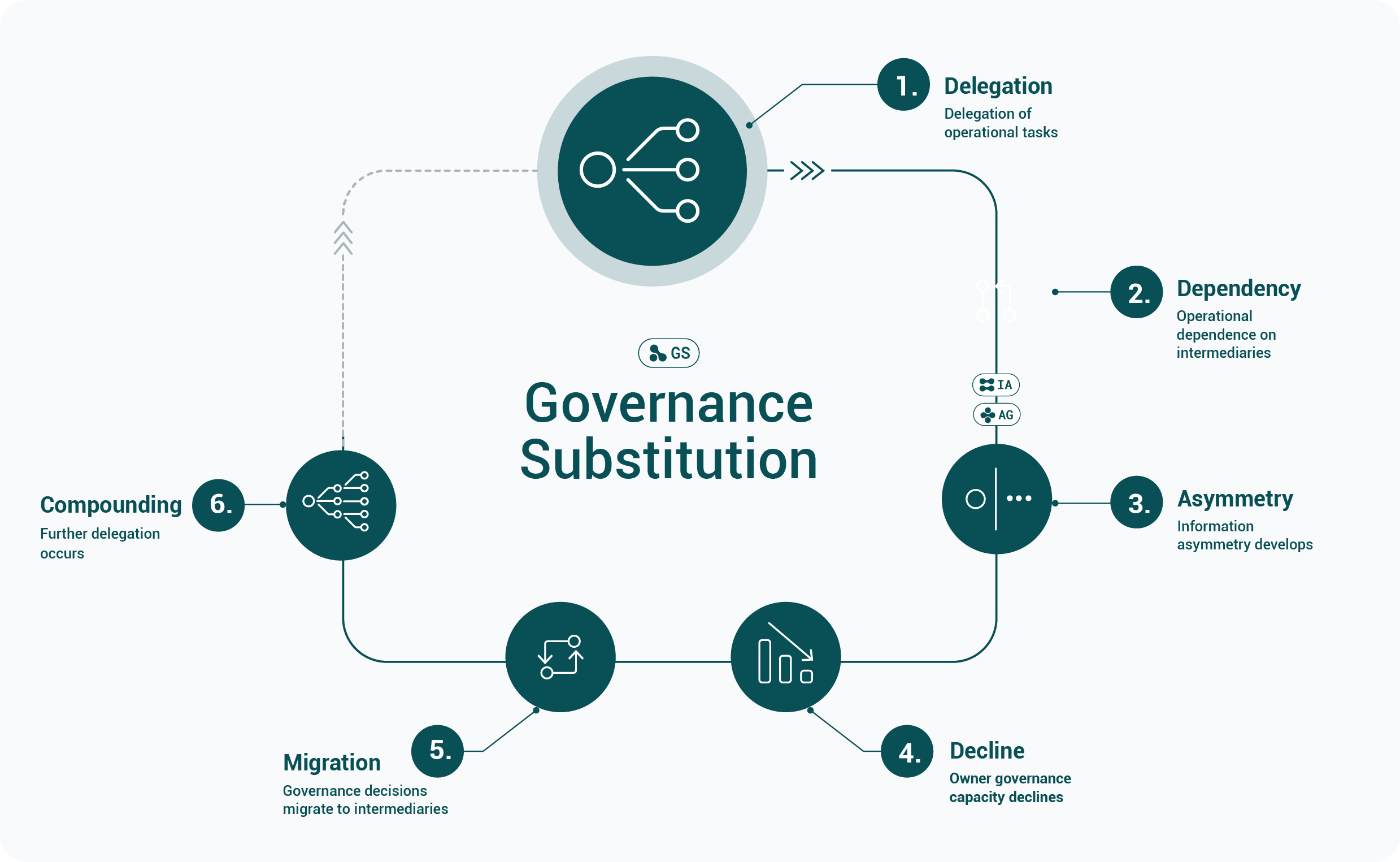
Governance substitution typically develops through repeated cycles of delegation, dependence, and declining governance capacity. Over time this produces a stable structure where operational actors control agenda and information, while formal governance bodies retain authority in form but not in practice.
4. Structural Test
Governance substitution is likely to be present where:
governance authority exists in law or governing documents,
operational actors determine agenda, information, or execution of decisions, and
members or committees cannot practically reverse or meaningfully influence those decisions.
Where these conditions are present, governance functions that formally belong to members or committees may be exercised elsewhere in the system.
From Governance to Substituted Governance
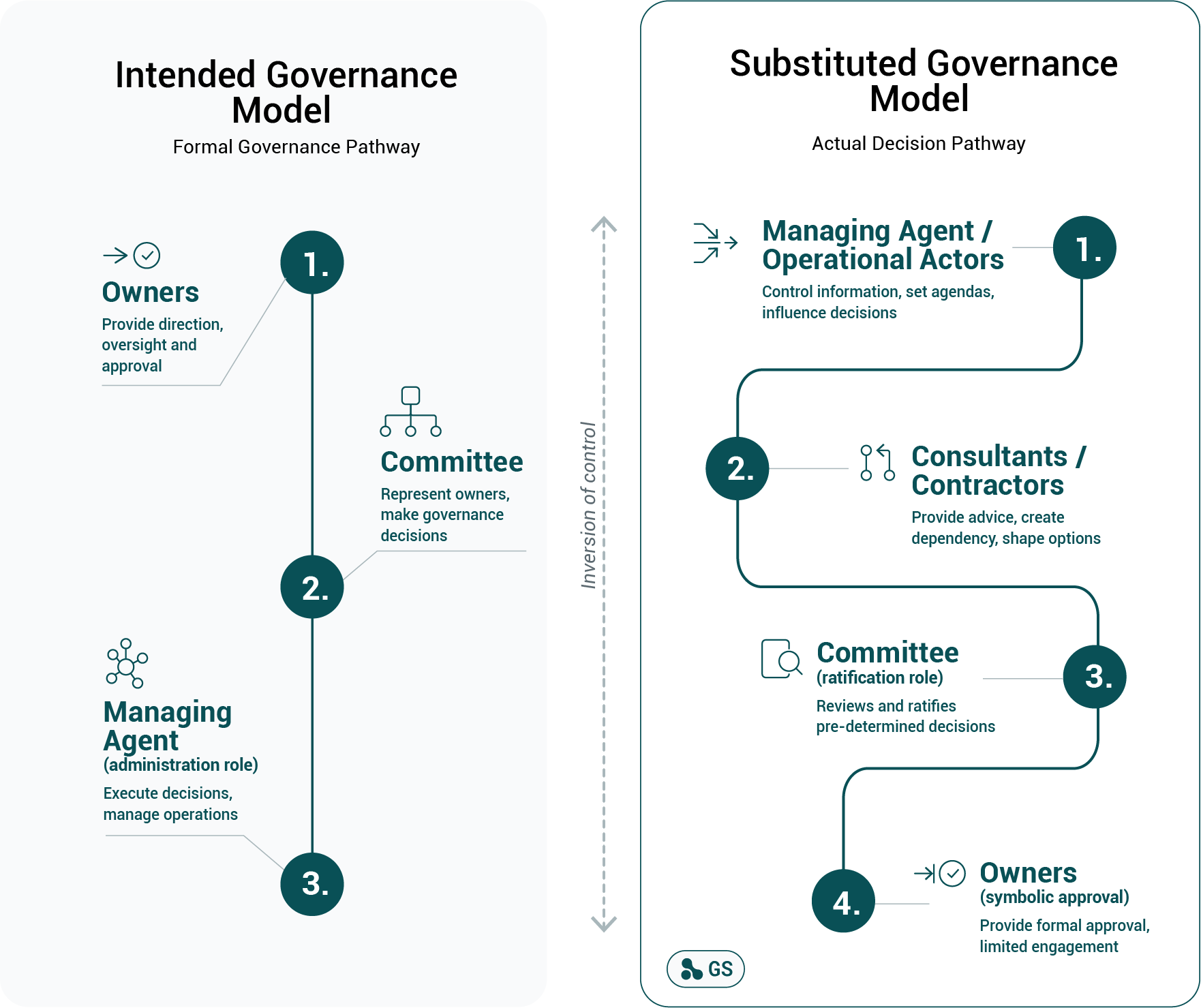
5. Structural Conditions
Governance substitution typically arises where one or more of the following conditions exist.
Delegated Operational Control
Managing agents, consultants, developers, or other intermediaries exercise continuing operational authority over governance functions.
External Agenda Formation
Decision agendas are substantially determined outside the formal governance body.
Information Gatekeeping
Information necessary for decision-making is filtered, selectively presented, or controlled by non-members.
Ratification Governance
Formal approvals function primarily to confirm or ratify decisions already made elsewhere.
These conditions may arise through:
contractual arrangements
regulatory complexity
administrative dependence
market practice
incentive misalignment.
6. Explanatory Function
This doctrine explains governance outcomes that cannot be adequately accounted for by:
low owner participation rates,
owner apathy or disengagement,
isolated procedural irregularities, or
formal compliance with meeting requirements.
Instead, the doctrine focuses on the location of effective authority within governance systems.
Where formal governance structures exist but do not control agenda formation, information flows, or operational execution, governance substitution has occurred.
7. Predictive Implications
Where Governance Substitution is operative, several structural outcomes commonly emerge.
Over time:
decision-making becomes increasingly centralised in non-elected actors
formal meetings become procedural rather than deliberative
voting becomes symbolic rather than determinative
accountability mechanisms weaken despite apparent procedural compliance.
Substituted governance structures may stabilise through contractual, informational, and financial dependencies that make re-entry of formal governance increasingly difficult.
These outcomes may arise even where participants act in good faith and within the scope of formal legal authority.
8. Relationship to Other Doctrines
Governance Substitution operates in conjunction with other GoStrata ARC doctrines. Each doctrine addresses a distinct structural dimension.
Incentive Alignment
Explains why governance substitution may emerge. Misaligned incentives often create pressures to centralise operational control.Capital Distortion
Explains how financial arrangements can stabilise substituted governance structures.Accountability Gap
Explains the weakening of consequence mechanisms once governance authority has been displaced.Information Asymmetry
Explains how control of information can enable substituted authority to persist.Fiduciary Distortion
Explains how fiduciary language may remain formally present even where effective authority has shifted.Procedure & Compliance Theatre
Explains how procedural compliance can mask the displacement of substantive governance authority.
These doctrines operate as analytical complements, not substitutes.
9. Scope Limits
This doctrine does not assert that:
delegation is inherently improper
professional management is undesirable
centralised operational coordination is inefficient.
Delegation and professional administration are normal features of complex governance systems.
The doctrine instead identifies circumstances in which formal governance bodies no longer exercise substantive authority over decision-making processes.
Governance substitution may develop gradually and without explicit intent.
10. Use and Citation
This doctrine may be cited in GoStrata ARC analytical materials including:
governance analyses
advisory memoranda
policy submissions
case reviews
reform proposals.
When cited, it should be referred to as:
Governance Substitution Doctrine (GoStrata ARC, Primary Doctrine, Issue 1.0)
11. Location
This doctrine is accessible via the GoStrata website as part of the GoStrata ARC doctrinal framework. [Link]
12. Version Control
This doctrine is subject to revision as GoStrata ARC analysis evolves.
Minor refinements will be reflected in incremental issue updates (e.g. Issue 1.1).
Substantive reconceptualisation will result in a new major issue (e.g. Issue 2.0).
13. Theoretical foundations (non-exhaustive)
The analytical framework underlying this doctrine draws upon established work in governance theory, institutional economics, and organisational analysis, including:
Robert Michels: Iron Law of Oligarchy
Max Weber: Bureaucratic authority and administrative rationalisation
James Burnham: Managerial Revolution
Oliver Williamson: Hierarchical governance and transaction cost economics
Douglass North: Institutional structures and governance systems
Berle & Means: Separation of ownership and control in corporate governance
End of Doctrine